
When AI Starts Remembering, Local-First Starts Mattering

Local-First AI Is Not Just About Privacy
Most conversations about local-first AI eventually come back to privacy.
Your data stays on your device. Your conversations don’t leave. Your documents aren’t sitting in someone else’s infrastructure.
Those are real advantages, and they’re worth having.
But privacy isn’t the part I keep coming back to lately.
There’s a meaningful difference between a system that stores what you said and a system that has been slowly building a picture of you over months.
Most AI products today are still session-oriented in practice. The interactions are mostly self-contained. Even where memory exists, it tends to stay lightweight — enough continuity that you don’t have to repeat yourself quite as much, but not enough to feel like the system is building a real model of who you are.
The picture of you, if it exists at all, stays shallow.
Once systems start going deeper, the question changes.
If an AI system is tracking what repeatedly trips you up, what keeps coming back, what you tend to avoid, what improves slowly, and what should be revisited later, the storage location stops feeling like an implementation detail.
It stops being just infrastructure.
A conversation log feels like data. A system that has spent six months building a representation of how you think feels like something else.
The line between “the model remembers some things about me” and “this system has a model of me” is hard to define precisely.
But you can feel when you’ve crossed it.
And once you cross it, where that model lives starts to matter in a different way.
This becomes most obvious in settings where the accumulation is personal.
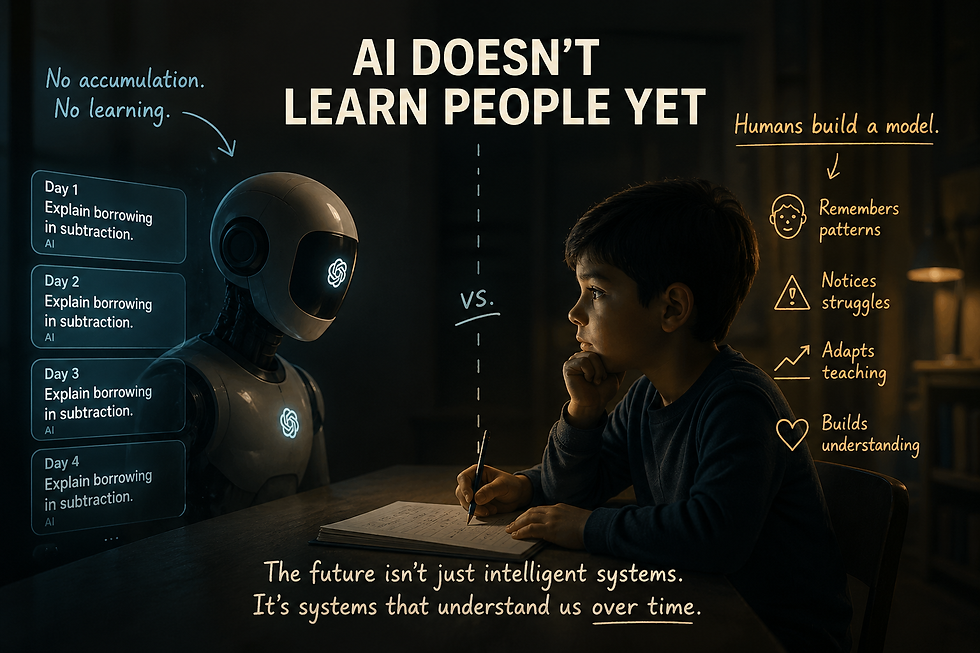
A system tracking a child’s learning over months — where they consistently struggle, what concepts quietly regress, what seems to click and then disappear — is doing something very different from answering homework questions.
At that point, the interaction data stops feeling like ordinary application state. It starts resembling something closer to a cognitive profile.
The same is true for health, long-running personal workflows, and any domain where the value of the system comes from how deeply it understands a person over time.
There is a real psychological difference between:
“the model remembers this conversation”
and
“this system has spent six months building a representation of how this person learns.”
Those are not equivalent, even if the underlying data looks similar in a database.
One feels like a log.
The other starts to feel like a portrait.
And portraits feel strange when you’re not sure who holds them.
Local-first architectures also change the engineering in ways that matter beyond ownership.
When memory and state stay on-device, the shape of the problem changes. You’re no longer designing every piece of personalization around a centralized, multi-tenant memory store. You don’t have to treat each user’s long-running context as something constantly competing with infrastructure built for scale first.
The problem gets narrower.
That can be a very good thing.
If you’re building something that evolves around one person over time, a narrower system can be easier to reason about. Persistence is simpler. Latency is more predictable. The system can carry forward user-specific state without constantly translating it through a cloud-first architecture.
This doesn’t make local-first easy. Local models are still constrained. Devices vary. Setup can be messy. You don’t get frontier-model capability for free.
But once continuity matters, the tradeoff starts to look different.
A smaller local model inside a stable, long-lived environment can sometimes feel more useful than a larger model that effectively resets across interactions.
Not because the smaller model is smarter.
Because the surrounding system is carrying forward more of the right things.
That is a different way of thinking about capability than benchmarks usually capture.
This is not an argument that AI should become entirely local. In many real-world systems, cloud infrastructure remains essential — for scale, heavy reasoning, orchestration, enterprise integrations, monitoring, and deployment. The interesting question is not cloud versus local. It is which parts of the system should live where. As AI systems become more personal and persistent, the long-running memory layer may deserve different treatment than the reasoning layer, the tool layer, or the orchestration layer.
Cloud systems tend to encourage disposable interaction patterns. You ask something, get an answer, and move on. The interaction is complete in itself.
Systems that persist on-device for months develop a different character. Users start expecting continuity. They notice when earlier interactions shape what happens next. They also notice when the system seems to know them in ways that are useful, but not fully inspectable.
That is where trust starts meaning something different.
Not just trust in model quality.
Trust in where the accumulated understanding actually lives.
The privacy conversation is real, but it mostly focuses on exposure — who can see what.
The ownership question is subtler. It is about who gets to decide what the model of you means, how long it persists, and what happens to it later.
As AI systems get better at building genuine continuity, that question is going to feel less abstract.
I don’t think it stays in the background for very long.

Comments